domingo, 28 de outubro de 2018

Feriadão em Lima II /A holiday weekend in Lima II


Continuando nosso passeio pelo MALI, uma visão geral de pintores  peruanos de diferentes épocas e escolas.

A quick view of some Peruvian Painters from different schools and time at MALI (The National Museum of Art of Lima).


Aníbal Santibañez (cerca 1955 sem título)


Benjamim Moncloa Zoo 1956


Carlos QUíZPEZ Asín  Calle Santa teresa 1926


Lajos D'Ebneth sem título 1966


José Sabogal Diéguez  Santusa 1928


Mateo Pérez
Virgen de la Leche  1604


Sabogal Diéguez Camilo Blas 1927


Funeral de Atahualpa
Louis Montero Piura - 1867


terça-feira, 9 de outubro de 2018

Feriadão em Lima I / A holiday weekend in Lima I

Mais uma vez em Lima (5 horas de voo) no feriadão de 20 de setembro.
E desta vez, Nosso Olhar começa com uma visita ao MALI - Museu de Arte de Lima - uma joia dentro do Parque de La Exposición, que apresenta uma coleção abarcando 3000 anos de arte no Perú. O próprio prédio já é uma obra impressionante. Construído no século XIX, é considerado uma das primeiras construções na América Latina feitas com uma nova técnica em ferro. O Museu foi inaugurado em 1961 e é considerado Patrimônio Histórico Peruano.


Once again in Lima . And our first post is about MALI -  The National Museum of Art of Lima - located in the Parque de La Exposición , that holds  a significant art collection in Peru tracing back 3000 years of history. The building itself is already a must see. Built in the XIX century, it is  one of the earliest and most important works built using the new technique of cast-iron construction in Latin America.


Parque de La Exposición


Museum / Museu


Começamos com apenas uma amostragem da Exposição  Plata de Los Andes , que oferece um panorama da história da prataria  desde o vice-reinado ao período republicano.

We start with  the Expo "Plata de Los Andes" that offers a wide-ranging overview of the history of silver from the viceroyal era to Peru's first century as a republic, mostly concerned with religious themes.   (XVI -XX century).


Mapa com a rota da prata/ Silver route map


Altarpiece / altar


Mask (circa 600-1000 A.D)
Máscara (entre os anos 600- 100 D.C)
Ostensório/ Monstrance


Depósito eucarístico  Lima (1740-1760)

Gold and Silver (Lima 1740- 1760) Ecclesiastical piece


sábado, 6 de outubro de 2018

Greenwich part 2

Em Greenwich, ainda seguindo o caminho do Royal Observatory onde se encontra o marco zero do meridiano, passamos pelo National Maritime Museum, talvez o maior museu desse estilo na Europa, retratando 2000 anos de história marítima. Um dos pontos altos, foi ter a oportunidade de ver o maior quadro pintado por Turner  A Batalha de Trafalgar . 

In Greenwich, in our way to the Royal Observatory where we can stand on the Prime Meridian ,  we visited the National Maritime Museum considered the largest museum with this theme in Europe, spanning 2000 years of maritime history. A lot of things to see; among them, Prince Frederick's Barge (1732), Figure Heads and , most important, Turner's largest painting The Battle of Trafalgar.


Prince Frederick's Barge (1732)


Figure heads from different ships 


The Battle of Trafalgar - Turner


Caminho do Royal Observatory
Greenwich Park 


Em 1675, Rei Charles II solicitou ao arquiteto Christopher Wren que construísse o Observatório Real Royal Observatory). Ele foi nomeado Flamsteed House em 1720 em homenagem ao primeiro astrônomo real que, junto com Edmond Halley, traçou as estrelas dos céus dos Hemisférios Norte e Sul. O Observatório funcionou por mais de 300 anos. Agora, serve como um museu de astronomia.

No  Observatório Real  uma das primeiras atrações é a seção remanescente do telescópio de 12 metros construído para William Herschel, astrônomo que se tornou famoso pela sua descoberta do planeta Urano em 1781.


"In 1675 King Charles II commissioned Sir Christopher Wren to build the Royal Observatory on the site of Duke Humphrey's medieval watchtower. It was named Flamsteed House in about 1720, after John Flamsteed, the first Astronomer Royal. John Flamsteed held the post of Astronomer Royal for 42 years. In the nearly 300 years it functioned as a working observatory, there were only nine other Astronomers Royal at Greenwich.
Between them, the first two Astronomers Royal – John Flamsteed and Edmond Halley – plotted all the stars visible in the northern and southern hemispheres. At the same time, because astronomy and time are inextricably linked, the Royal Observatory was key in helping to develop accurate clocks."

Read more at https://www.rmg.co.uk/royal-observatory/history#s0c3MMDAej8Cd8Vr.99


At the Royal Observatory, one of the first things we can see is the remaining section of a 12m telescope built for the astronomer William Herschel who became famous for his discovery of the planet Uranus in 1781.

William Herschel's telescope


Flamsteed House


Relógio  construído em 1974 pelo relojoeiro Martin Burgess, usando uma teoria radical proposta por John Harrison, que fez o primeiro relógio marítimo prático em 1775.  O grau de erro é de 1/2 segundo a cada 100 dias. 

Clockmaker Martin Burgess began to build the clock (known as Burgess Clock B) in 1974 using a radical theory proposed by John Harrison, maker of the first practical marine timekeeper around 1775. The clock's performance is of high level, varying only half a second every 100 days.


Burgess Clock B


Harrison's watch


segunda-feira, 10 de setembro de 2018

Greenwich part 1


No porto em Greenwich, uma das primeiras atrações que se vê é o Cutty Sark, construído em 1869, para a Cia. Jock Willis Shipping Line. Foi um dos últimos veleiros mercantes grande porte da Grã-Bretanha .  Faz parte da lista do National Historic Ships ( Navios Históricos da Nação). Só restam três desses navios construídos com casco de madeira em uma estrutura de ferro do século 19.

When we arrive at Greenwich Pier, one of the first attractions we see is the Cutty Sark, built in 1869 for Jock Willis Shipping Line, one of the last tea clippers of Great Britain. Cutty Sark is listed by National Historic Ships as part of the National Historic Fleet. She is one of only three remaining original composite construction (wooden hull on an iron frame) clipper ships from the nineteenth century. 

CUTTY SARK


Continuando o passeio, temos no Old Royal Naval College, um grupo de prédios históricos , construídos por Sir Cristopher Wren  no ano de 1751. Ambos tinham o propósito de servir a Marinha ; o primeiro era um hospital, o segundo, casa de repouso. Posteriormente, serviu como Colégio Naval Real. Agora, os dois prédios fazem parte da Greenwich Marinha, Patrimônio Histórico da UNESCO.
Neles, pode-se visitar a Capela de São Pedro e São Paulo, construída por Thomas Ripley a partir dos projetos de Christopher Wren. 


After the Cut Sark, we can visit the Old Royal Naval College a World Heritage Site in Greenwich, The buildings were originally constructed to serve as the Royal Hospital for Seamen at Greenwich  designed by Christopher Wren, and built between 1696 and 1712. The hospital closed in 1869. Between 1873 and 1998 it was the Royal Naval College, Greenwich.The site is managed by the Greenwich Foundation. 
The Chapel of ST Peter and St Paul, built by Thomas Ripley to the designs of Sir Christopher Wren, was finished in 1751. It was burned down in 1779 and rebuild in a Greek Revival style.


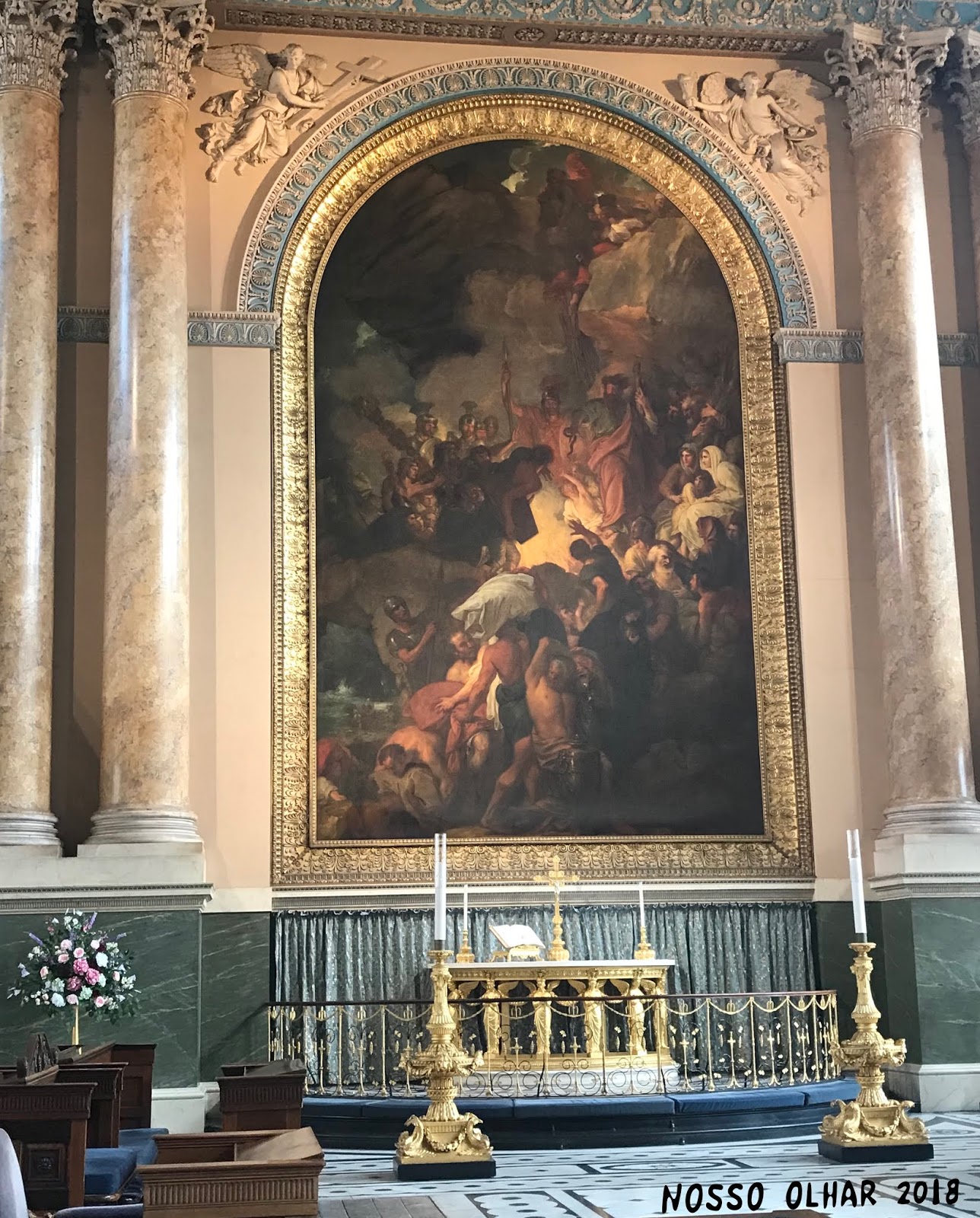
The Chapel of St Peter and St Paul


A pintura  do retábulo é de Benjamin West e mostra a história do naufrágio de São Paulo na Ilha de Malta. A pintura de 7,5 metros levou sete anos para ser feita e é o único retábulo de West que permanece no lugar para o qual foi feito.

The painting above the altar  by Benjamin West took 7 years to complete. It shows the story of St Paul's shipwreck on the island of Malta. It is the only one of West's altarpiece to rain in the same place for which it was commissioned.


O órgão é feito de mogno espanhol . Foi construído por Samuel Green em 1789 e até hoje é usado quase que diariamente por organistas, tanto na hora da Missa, quanto em apresentações e concertos.

The Chapel organ is the work of Samuel Free, made of Spanish Mahogany and the organ gallery is supported by six fluted marble columns. It was completed in 1789 and is used almost every day.


No outro prédio do College, encontramos o famoso Salão Pintado, considerado um dos mais espetaculares interiores barrocos da Europa. As paredes e o teto foram concebidos e pintados por Sir James Thorhill entre 1707 e 1726. Atualmente, o salão está passando por uma restauração. Só voltará a ser aberto ao público em 2019, mas se pode comprar uma entrada para se subir nos andaimes que cobrem todo o espaço e ver como o processo  está sendo feito por vários artistas .

The Painted Hall at the Old Royal Naval College, Greenwich is one of the most spectacular and important baroque interiors in Europe. Its ceiling and wall decorations were conceived and executed by the British artist Sir James Thornhill between 1707 and 1726 at the pivotal moment when the United Kingdom was created and became a dominant power in Europe. It is currently closed for a major conservation process.

Read more at https://www.ornc.org/history-of-the-painted-hall#8bidzAIrrbPmSVGt.99